
The Sicilian Wine Harvest: What's Happening on Etna Right Now
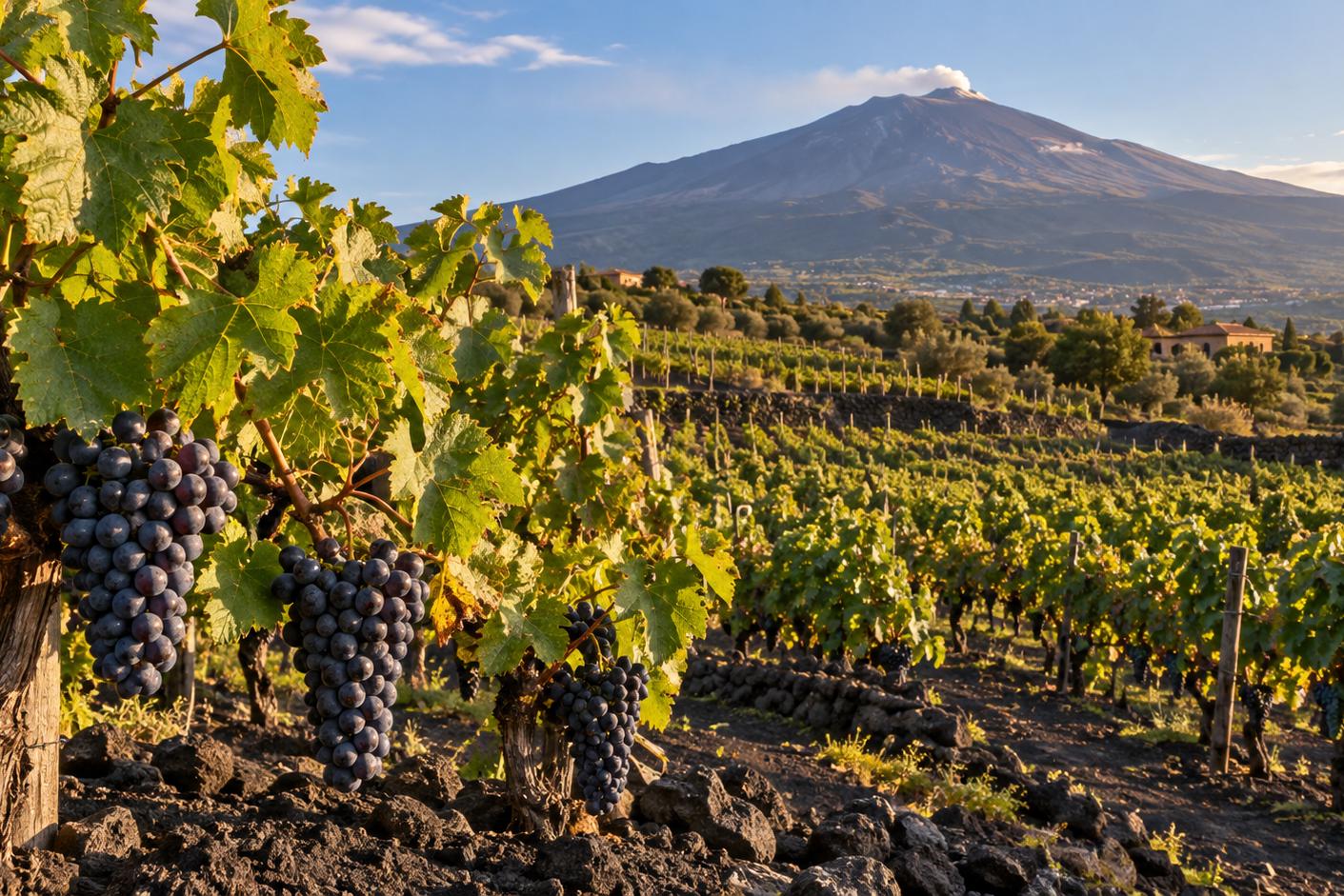
Right now, while you are reading this, people are picking grapes on the side of an active volcano.
Sicily's harvest started back in late July on the western end of the island and it runs for nearly one hundred days, finishing at the end of October and sometimes into early November. The last place on the whole island to pick is Mount Etna. That is not a scheduling quirk. It is the entire reason Etna wine tastes the way it does.
Why does the Sicilian harvest take one hundred days?
Sicily is not one climate. It is a stack of them.
The western end of the island is warm and low and close to the sea, so the white grapes there come in first, in the last days of July. From there the harvest moves east across the island in a slow wave, variety by variety, altitude by altitude. Every week something different is ready somewhere.
Etna sits at the end of that wave. Vineyards on the mountain run from around 400 meters above sea level up past 1,000, and the best sites climb higher still. Up there it is cool, the air moves, and the nights are genuinely cold even in September. Grapes ripen on their own schedule, and that schedule is late.
Why does Etna pick last?
The short version: altitude buys time.
On Etna the gap between a warm afternoon and a cold night is wide, wider than you would expect anywhere in the Mediterranean at that latitude. Warm days build sugar and flavor. Cold nights slow everything down and protect acidity. The grapes hang on the vine for weeks longer than they would in a warm, flat vineyard, and all that extra time goes into aroma and detail rather than raw ripeness.
Nerello Mascalese, the red grape that makes Etna Rosso, is a late ripener by nature, and on Etna it generally comes in around the middle of October. Carricante, the white grape behind Etna Bianco, works to the same unhurried clock.
That is why these wines taste bright and lifted instead of heavy and sunbaked, even though they grew in Sicily. They are Sicilian wines made at a Burgundian tempo.
What do the vines on Etna look like?
Not like a modern vineyard.
Much of Etna is planted in alberello, a low bush training system, packed at high density, each vine standing more or less on its own. It is beautiful and it is entirely handwork. No machine is getting into those rows.
Better still, a lot of Etna is ungrafted. The sandy volcanic soil made life difficult for phylloxera, the root louse that wiped out most of Europe's vineyards in the late 1800s, so parcels of original pre-phylloxera vines survived on the mountain. Some of them are well over a century old and still producing. When a bottle says piede franco, that is what it is telling you.
What does contrada mean on an Etna wine label?
Not the producer. The contrada.
A contrada is a historic vineyard district on Etna, and they function very much like the named climats of Burgundy. Same mountain, same grape, same year, and a wine from Guardiola will not taste like a wine from Calderara Sottana. Lava flows on Etna arrived at different times and in different places, so the soil changes from one district to the next, sometimes over a few hundred meters.
Here is the part worth knowing before you sit down with us. Our list carries three different producers bottling from the same contrada, Rampante, on the northern slope: Pietradolce, Tascante, and Passopisciaro. Three winemakers, one vineyard district. Open two of them at the same table and you are tasting the difference between two people rather than two places, which is a lesson you cannot get from a book.
We also pour from Guardiola, Calderara Sottana, Arcurìa, and Pietramarina, and Giro is happy to walk you through what separates them.
Which slope of Etna makes the best white wine?
The eastern one.
Etna's growing area wraps around the mountain, and our list splits it into four sides: northern, eastern, south-eastern, and south-western. The northern slope gets the attention and the scores. The eastern slope deserves more of both.
The east faces the Ionian Sea. It is cooler and greener, it catches sea air and rain, and it is the only place allowed to make Etna Bianco Superiore, a designation restricted to the commune of Milo. Carricante grown there gets salty, mineral, and unusually long-lived. If you think of Sicilian white wine as something to drink young and quickly, Milo is the bottle that changes your mind.
How is the 2026 Etna vintage shaping up?
Early signs are good.
A rainy winter and spring left the vines with steady, balanced growth going into summer, and there has been little pressure from pests or disease. Growers are expecting wines with strong aromatic complexity and a good balance of freshness and elegance. On a mountain where freshness is the whole identity, that is the report you want.
One honest caveat: the 2026 harvest is not what you will drink this fall. Etna reds in particular need a few years before they are poured. What is being picked right now arrives on our list in 2028 and beyond. The bottles open tonight came from earlier vintages that went through this same hundred-day wave a few years ago.
Which Etna wines can I try in Salt Lake City?
By the glass, if you want to start somewhere easy:
Murgo Brut, Nerello Mascalese, 26. Sparkling Etna, made in the traditional method. A good argument for opening the night with the mountain.
Benanti Etna Bianco 2023, 27. Carricante doing exactly what Carricante does.
Alta Mora Etna Rosso 2022, 30. Northern slope, poured by Coravin, a clean introduction to Nerello Mascalese.
By the bottle, if you want to go further:
Il Vulcano di Elisa 2024, 90. Eastern slope white, the affordable way into that sea-facing style.
Barone di Villagrande Superiore 2024, 115. Etna Bianco Superiore from Milo.
Calcaneus Etna Rosso 2022, 100. Northern slope, and our most-poured Etna red.
The Rampante flight. Pietradolce Contrada Rampante 2018, 155. Tascante Contrada Rampante 2021, 180. Passopisciaro "R" Contrada Rampante 2022, 250. One vineyard district, three points of view.
And if you would rather not choose, that is what Giro is for. He grew up in Taormina with the mountain in the window and he holds a level-three sommelier certification. Tell him whether you want something bright or something serious and let him take it from there.
Quick answers
When is the Sicilian wine harvest? It begins in late July in western Sicily and runs close to one hundred days, wrapping up at the end of October or in early November.
When is the harvest on Mount Etna? Roughly mid-September through the end of October, occasionally into November. Nerello Mascalese is usually picked around the middle of October.
Why does Etna harvest later than the rest of Sicily? Altitude and cold nights. Vineyards sit between about 400 and 1,000 meters, which slows ripening and keeps acidity high, so the grapes stay on the vine longer.
What is a contrada? A named historic vineyard district on Etna. It works like a Burgundy climat, and it tells you more about how a wine will taste than the producer's name does.
Where can I drink Etna wine in Salt Lake City? At 'mina, on 900 South. Our list is organized by which slope of the volcano the grapes grew on, with Etna available by the glass and by the bottle.
Your seat at the table awaits.