How to Read a Wine List When You Don't Recognize a Single Bottle
You do not have to recognize anything on a wine list. That is the first thing worth saying, and almost nobody says it out loud.
Ordering wine well takes two pieces of information.
1. What you usually like.
2. What you want to spend.
Everything else belongs to the person standing at your table.
What follows is how a wine list is actually built, what the words on each line mean, and how to say the thing you are probably worried about saying. It works at our table, and it works at anybody else's.
Why don't I recognize anything on the list?
Because the list was not organized for you. It was organized for the wine.
Nearly every restaurant list follows the same grid. First by color and style: sparkling, white, rosé, red, dessert. Then by place. Then, inside each place, by producer. That is the whole structure. Once you can see the grid, you can find your way around a list in any restaurant in the world, whether or not a single name on it is familiar.
The names feel foreign because Italian wine is usually named for where it comes from rather than what it is made from. Which brings us to the part that trips everyone.
What do the words on each line actually mean?
Here is a real line from our list:
Benanti, Etna Bianco, Sicilia, 2023, 27
That is producer, wine, region, vintage, price.
Benanti is the family making it.
Etna Bianco is the wine.
Sicilia is the island.
2023 is the year the grapes were picked.
Twenty-seven is what a glass costs.
Now a different one:
Feudo Montoni, Nero d'Avola, Lagnusa, Sicilia, 2022, 22
Same grid, one difference. Nero d'Avola is a grape rather than a place, and Lagnusa is the vineyard it grew in.
Here is the thing nobody explains. On an Italian list, the prominent word is sometimes a grape and sometimes a place, and you often cannot tell which just by looking. Barolo is a place. Chardonnay is a grape. Chianti Classico is a place. Grillo is a grape. Etna Bianco is a place, and the place decides which grapes are allowed in the bottle.
You do not need to memorize which is which. You only need to know that both things are happening, so you can stop assuming you are missing something obvious. You are not.
How do I say what I like without sounding like I know nothing?
Say what you actually drink, not what you think sounds correct.
"I usually drink Sauvignon Blanc and I like that it's sharp."
"I like big reds, but not the ones that dry my mouth out."
"The best white I ever had was a Pinot Grigio on vacation and I have no idea what it was."
All three of those are more useful than any wine term you could reach for. A sommelier does not need vocabulary from you. They need direction.
And if you have no idea, say that. "I don't know what I like, surprise me" is a complete sentence and a real answer. So is naming something you did not enjoy, which is often more useful than naming something you did.
How do I bring up price without it being awkward?
Point at a number, or say one out loud. Whichever is easier.
Both are completely normal, and neither one tells anybody anything about you except how much you would like to spend, which is the exact information the person serving you wants. Someone who knows your number can do their job well. Someone who is guessing is working blind, and the most common outcome of guessing is aiming too high and leaving you feeling cornered.
If saying it aloud feels strange, put a finger on a line on the list and say "something around here." Nobody at your table will notice, and nobody on the other side of the list will think about it for even a second.
Can I try something before committing to a whole glass?
Sometimes, and it comes down to a piece of equipment worth knowing about.
A Coravin is a device with a very thin needle that passes through the cork, draws out wine, and replaces it with argon gas. The cork reseals itself. The bottle is never actually opened, so it does not begin to oxidize, and what remains keeps for months.
What that means for you is simple. A restaurant can pour a single glass from a bottle it would never open otherwise. On our list, the selections poured this way are marked with an asterisk, and they are worth looking for, because that is where a by-the-glass list stops being safe and starts being interesting. Vietti Barolo Monvigliero. Gaja Barbaresco. Benanti Pietramarina, the Etna Bianco Superiore from Milo. Bottles that run into the hundreds, available for the price of one glass.
If you have ever been curious about a wine you would never buy a whole bottle of, the asterisk is your answer.
Should I just let the sommelier choose?
Yes, and it is not a surrender.
Giro, our co-owner, is a sommelier, and he is on the floor most nights. Handing him the decision is not giving up. It is using the most informed person in the room, which is what he is there for.
One thing worth understanding about the job. A sommelier is not trying to sell you the most expensive thing you will agree to. A sommelier is trying to make you happy inside the number you gave them, because a guest delighted by an eighty dollar bottle comes back, and a guest talked into a two hundred dollar bottle does not.
What if the list is organized in a way I have never seen?
Then ask, because an unusual organization is almost always a clue about what the restaurant cares about.
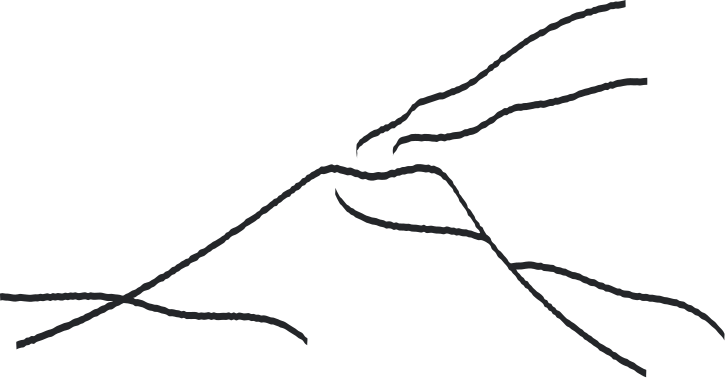
Ours is arranged by which slope of a volcano the grapes grew on. That sounds like a flourish, and it is the most practical thing on the list. Mount Etna is an active volcano in eastern Sicily, and the side of the mountain a vineyard sits on changes the wine more than the producer does.
The northern slope has younger soil from recent lava flows and cooler temperatures. Those wines are precise and mineral, with fine-grained structure. People compare them to Burgundy or Barolo, not for power but for exactness.
The eastern slope faces the Ionian Sea and takes the sea air and the rain. Salinity, energy, and clarity. It is where Carricante, the white grape of Etna, is at its most expressive, especially around the town of Milo.
The south-eastern slope gets the most sun. Warmer and drier, and the reds from there are deeper and firmer, with more weight on the palate.
The south-western slope sits high, much of it above three thousand feet, on older decomposed soil. The altitude cools the sun back down. Those wines are softer and more aromatic, and they hold up across a long meal.
So you can order by mood without knowing a single producer. Something bright and mineral sends you north or east. Something rounder and warmer sends you south-east or south-west. That is a real instruction you can use tonight, and you now have it.
What is the one question that makes any wine better?
Ask why it is on the list.
Every bottle in a serious restaurant is there because somebody chose it over a hundred others. Ask why, and you will get a reason, and the wine will taste better for your having heard it. Our own list says so on its first page: if something catches your eye, ask us why we love it.
One more small thing while we are here. If you order something sparkling with us, you can have a spoonful of strawberry or lemon granita dropped into the glass for six dollars. It is the most Sicilian six dollars on the list, and it is a very good way to begin a night.
None of this asks you to learn anything before you arrive. It asks you to say two true sentences to somebody who wants to help. That is the whole skill, and you already have it.
Quick answers
How do you read a restaurant wine list? Most lists follow the same grid: color and style first, then region, then producer, then vintage and price. Once you can see the grid you can navigate any list, whether or not you recognize the names.
What should I say to a sommelier? Two things. What you normally drink and what you like about it, and roughly what you want to spend. Wine vocabulary is not required.
Is it rude to tell a sommelier your budget? No. It is the single most useful thing you can tell them. Say a number out loud or point at a price on the list. Both are completely normal.
What is a Coravin? A device that draws wine through the cork with a thin needle and replaces it with argon gas, so the bottle is never opened and does not oxidize. It lets a restaurant pour one glass from a bottle it could not otherwise offer by the glass.
What is Etna wine? Wine grown on the slopes of Mount Etna, an active volcano in eastern Sicily. The slope matters. Northern is precise and mineral, eastern is saline and bright, south-eastern is deeper and warmer, south-western is high altitude and softer.
What if I don't know what I like? Say so. "Surprise me" is a real answer, and naming a wine you did not enjoy is often more useful than naming one you did.
Your seat at the table awaits.