Sicilian Food vs. Italian Food: What's the Difference?
Guests ask it almost every night: isn't Sicilian food just Italian food? It's a fair question, and we love answering it, because the answer is one of the best food stories ever told.
The short version: Sicily is an island in the middle of the Mediterranean that spent about 2,500 years being conquered by nearly everyone who owned a boat. The Greeks came, then the Romans, the Arabs, the Normans, the Spanish. Every one of them left something behind in the kitchen. What came out the other side is a cuisine that is Italian on paper and entirely its own thing on the plate.
Here's the longer version, and it's worth the read.
First, a secret: "Italian food" isn't really one thing
Italy only became a single country in 1861. Before that it was a collection of kingdoms and city-states, and every region still cooks like it remembers. Milan cooks with butter, rice, and saffron. Bologna gave the world its ragù and its Parmigiano. Naples gave us pizza. Rome has its four famous pastas and will argue about all of them.
So when Americans say "Italian food," they usually mean a blend of southern Italian home cooking that immigrated a century ago. Real Italian food is regional, fiercely so. And of all the regions, Sicily is the one that stands furthest apart, because it's an island, and because of who kept showing up on its shores.
The island everyone wanted: a 60-second history
The Greeks arrived around 2,700 years ago and planted olives and grapes. The Romans turned Sicily into the granary of the empire, fields of durum wheat that still make the island's bread and pasta what they are.
Then, in the 9th century, the Arabs arrived, and the Sicilian kitchen changed forever. They brought lemons and blood oranges, sugarcane, almonds, pistachios, saffron, cinnamon, rice, and eggplant. They packed mountain snow from Mount Etna with fruit and flowers, and granita was born. And here's our favorite part: the first written record of dried pasta being made anywhere is from Trabia, near Palermo, in the year 1154. That's a full century before Marco Polo was born, so we can politely retire the story about pasta coming from China.
The Normans and the Spanish came later and layered on their own tastes, including the sweet-and-sour instinct Sicilians call agrodolce, and eventually the tomato, which arrived from the New World and made itself at home.
Every conquest ended. The recipes stayed.
So what actually makes Sicilian food different?
Citrus, everywhere. Lemons and blood oranges grow in nearly every Sicilian yard, and they show up in salads, over fish, in desserts, and in drinks. A winter salad of blood orange and shaved fennel is about as Sicilian as a sentence gets.
Pistachio is treated like royalty. The pistachios grown in Bronte, on the slopes of Mount Etna, are called green gold, and Sicilians put them on everything: pasta, meat, gelato, pastry. Once you've had pistachio treated this way, you understand the nickname.
The sea comes first. Swordfish from the Strait of Messina, tuna, sardines, anchovies. One dish, pasta con le sarde, holds the whole history in a single bowl: sardines, wild fennel, saffron, pine nuts, and raisins. Half Mediterranean, half Middle Eastern, entirely Sicilian.
Eggplant is a main character. Caponata, pasta alla Norma. In much of Italy eggplant is a side note. In Sicily it gets top billing.
Olive oil, not butter. The further north you go in Italy, the more butter and cream you find. Sicily cooks in olive oil, and finishes with it too.
Dessert is a religion. Cannoli and cassata built on sheep's milk ricotta, almond pastries, granita with warm brioche for breakfast. Palermo takes its pastry as seriously as any city on earth, which is exactly why our pastry chef Francesco is from there.
The dishes that tell the story
You can taste every chapter of that history at our table in Salt Lake City.
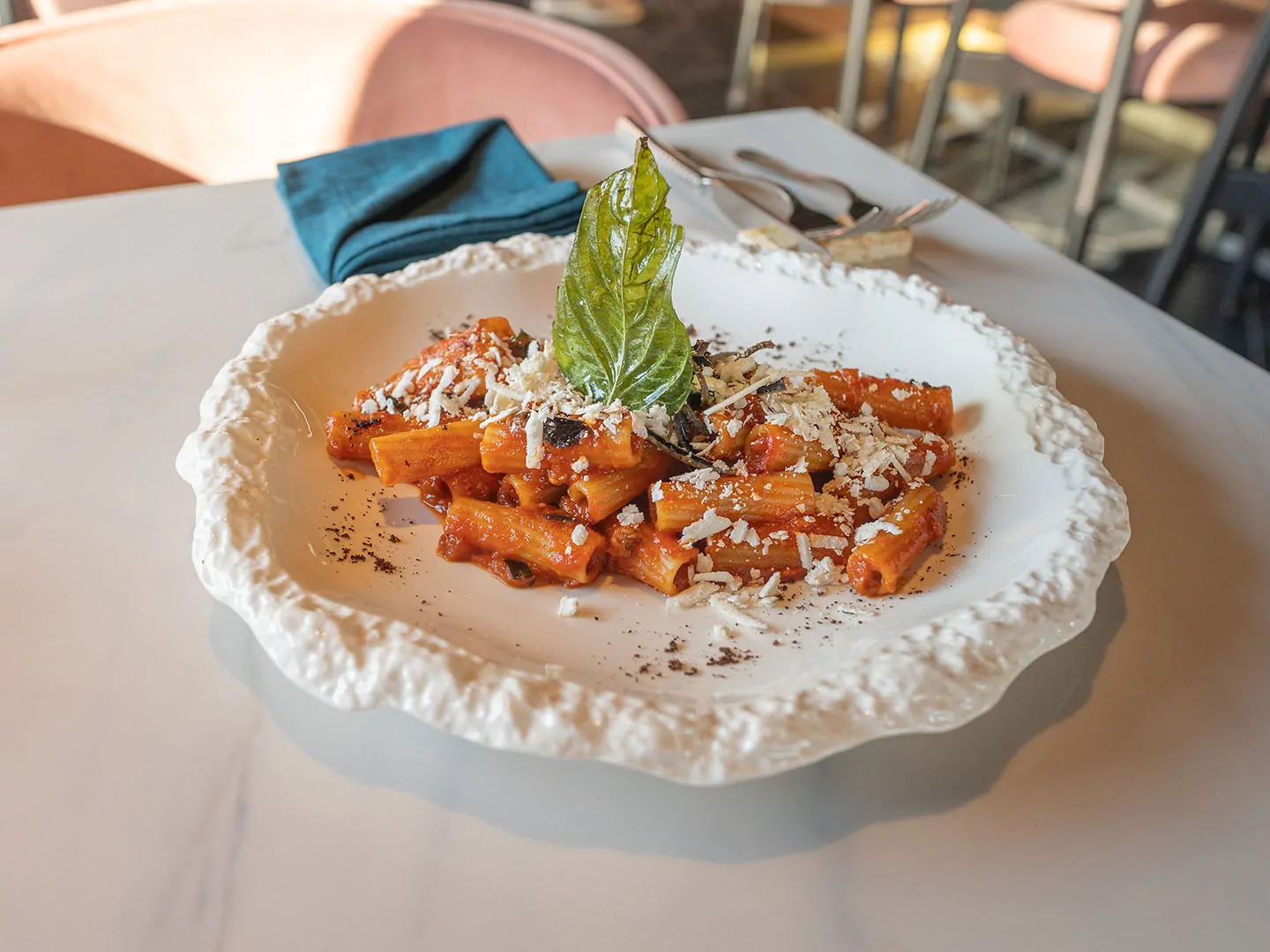
Pasta alla Norma is Catania's signature: eggplant, tomato, and a snowfall of ricotta salata over pasta. The dish is named after the opera Norma by Vincenzo Bellini, Catania's favorite son, supposedly because a local playwright tasted it and declared it a masterpiece worthy of the maestro. Our version is rolled by hand every day from stone-milled ancient Sicilian grains, the same durum wheat the Romans prized.
Arancini are Sicily's beloved street food, golden rice spheres with a molten center. In eastern Sicily they're shaped into cones in honor of Mount Etna, and that's how we shape ours.
Cannoli only deserve the name if the shell is crisp, which is why we fill them at your table, to order, with sheep's milk ricotta. A cannolo filled hours ahead is a soggy apology.
And the wine list tells the same story. Etna's volcanic slopes grow Nerello Mascalese, a red that drinks like the island tastes. Giro, our co-owner and host, grew up in Taormina with Etna on the horizon, and he chooses every bottle himself.
Why we think Salt Lake City gets it
Salt Lake has wonderful Italian restaurants, and we're happy to be in their company. But a fully Sicilian table is a rare thing here. At 'mina, the chef is from Catania, the pastry chef is from Palermo, and your host grew up in Taormina.
And honestly, we think a city that lives at the foot of the mountains understands an island that cooks at the foot of a volcano. You plan your days around something enormous and beautiful on the horizon. So do Sicilians. Theirs just occasionally makes wine better.
Come taste the difference
The real answer to "what's the difference between Sicilian and Italian food" is dinner. Words only get you so far; the blood orange gets you the rest of the way. Explore the menu, or reserve below.
Quick answers
Is Sicilian food spicy? Not especially. Sicilian cooking builds flavor from citrus, herbs, olive oil, and the sweet-and-sour balance of agrodolce rather than heat.
What is Sicily's most famous dish? Depends who you ask, and Sicilians will ask loudly. Pasta alla Norma, arancini, caponata, and cannoli all have a claim.
Did pasta come from China? The oldest written record of dried pasta production is Sicilian, from Trabia in 1154, about a century before Marco Polo's travels.
Is Sicilian food good for gluten-free diners? At 'mina, yes. Almost any dish on our menu can be prepared gluten-free, with a dedicated process to protect against cross-contact. Just tell your server.
Your seat at the table awaits.