
The Best Sicilian Restaurants in Salt Lake City: Where to Eat Tonight
On discussion boards and social media groups one question keeps returning: what is the best restaurant for Italian food in Salt Lake City? Everyone has their favorite.
We understand the importance of this question. When you make the decision to go out for dinner you want delicious food, incredible service, and to return home thinking about the next time you're going to head back to the restaurant. Sometimes cost matters, sometimes, you'll pay whatever it takes to create a night to remember.
Let's state the obvious. We are Sicilian, we love food, and we own 'mina. We might not be the best fit for you and you should spend your evening with one of the other fabulous Salt Lake City restaurants such as Urban Hill or Le Depot. Nonetheless, this article will discuss the best Italian restaurants in Salt Lake City or more specifically, who is authentically cooking Sicilian cusine and which one is best for you.
Salt Lake City has a good Italian restaurant scene. Better than good. But, Sicilian is a different question, and the answer is that very little of it exists here.
We went looking, carefully, restaurant by restaurant, at every Italian place in the valley. Arancini and cannoli turn up in a number of them. Almost everything else that makes Sicily its own kitchen, the sfincione and the panelle and the busiate and the granita, is essentially absent.
What makes food Sicilian, and not just Italian?
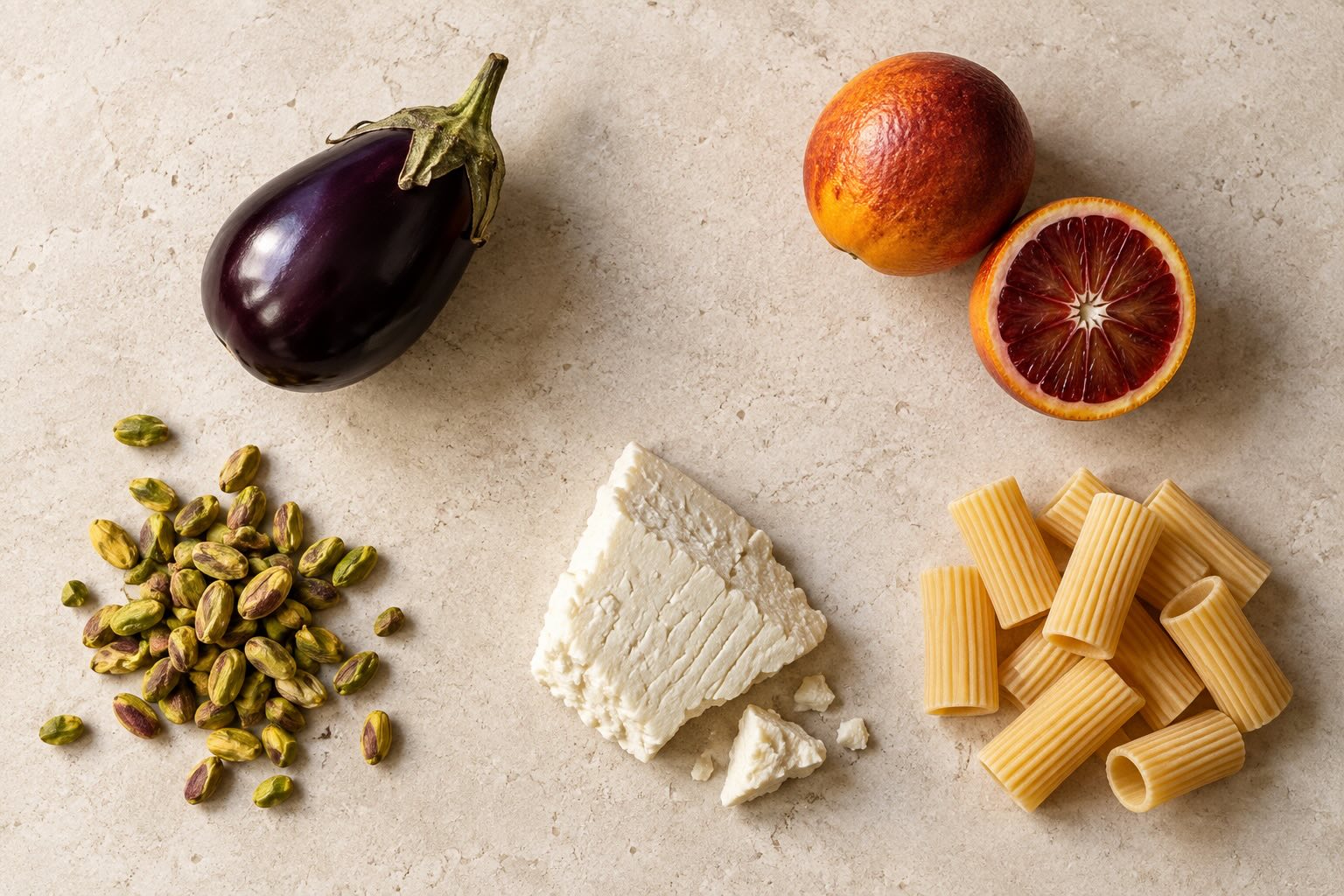
Sicily is an island that sat at the center of the Mediterranean for three thousand years, and everyone who sailed past left something in the kitchen. The Greeks brought olives and wine. The Arabs, in the ninth century, brought citrus, sugarcane, almonds, pistachios, saffron, cinnamon, rice, and eggplant. The Spanish brought the sweet-and-sour instinct Sicilians call agrodolce. What came out the other end is Italian on the map and its own thing on the plate.
So when you are reading a menu, look for these:
Citrus and pistachio. Blood oranges, lemons, and the green pistachios of Bronte turn up in savory dishes, not just dessert. A pistachio crust on fish or meat is a Sicilian signature.
Eggplant as a main character. Caponata and pasta alla Norma both build a whole dish around it. In most of Italy eggplant is a side note.
Ricotta salata. Pressed, salted, aged ricotta, grated over pasta like snow.
Seafood from the strait. Swordfish, tuna, sardines, anchovies, prepared simply.
Semolina pasta, not egg pasta. Sicily is durum wheat country, which means a firmer bite and a rougher surface.
Sweet and sour together. Raisins and pine nuts in a savory dish. Vinegar and sugar in the same pan. That is agrodolce, and it is unmistakably Sicilian.
None of this is a grade. Plenty of excellent Italian restaurants are not Sicilian at all. The checklist tells you what you are eating, not whether it is good.
Where to find Sicilian food in Salt Lake City
Antica Sicilia, BASTA Pasteria, and Sicilia Mia. Three names, four locations, one family, and the best-known Sicilian name in the valley. Antica Sicilia is at 2020 E 3300 South, Sicilia Mia at 4536 S Highland Drive, and BASTA Pasteria has locations on State Street in Murray and 12300 South in Draper.
Their signature is the carbonara finished inside a wheel of 24-month Parmigiano Reggiano, which they have been serving since 2014.
Carbonara is Roman rather than Sicilian, and the menu ranges across Italy. The Sicilian items are the arancinette, the cannoli, and an affogato with pistachio cream.
Caputo's Market & Deli. Downtown at 314 W Broadway, plus 15th and 15th and Holladay. Not a restaurant, but if you are cooking Sicilian at home this is where the ingredients are. They carry Sicilian green olives and Castelvetranos, and the muffaletta at the counter is a Sicilian-American invention by way of New Orleans.
Tony Caputo founded the place. He passed away in 2021 and his son Matt runs it now.
Cosmica. 945 S 300 West, in Central Ninth. Not a Sicilian restaurant, and they do not claim to be, but their own description is worth quoting: "From Sicily to Naples to Rome, our menu mostly roams the southern half of Italy's food legacy."
In September 2025, less than a year after opening, they made the New York Times' America's Best Restaurants list. Executive chef is Zachary Wade. The elk carpaccio and the bread are what to order, and reservations got harder after the Times showed up.
'mina. We are at 439 E 900 South, and we are Sicilian throughout. Giro, our co-owner, grew up in Taormina, the town we are named for. Chef Leonardo Li Mura grew up in Catania. Our pastry chef, Francesco Biondo, is from Palermo. The pasta is rolled by hand from stone-milled Sicilian grains, the arancini are shaped like Mount Etna, the cannoli are filled at your table, and the wine list is organized by which slope of the volcano the grapes grew on.
Run us through the checklist above and we hold up. Run the others through it too.
Osteria Amore. 224 S 1300 East. Executive chef and partner Marco Cuttaia grew up in Palermo. Owner Eduardo Daja trained in Bologna from his teens. The menu runs northern technique and southern cooking at the same time.
If you want food cooked by someone who grew up in Sicily, this is one of the few doors in Salt Lake City.
Why is there so little Sicilian food here?
A few reasons, and they are more interesting than you would expect.
Most of what Americans call Italian food arrived with immigrants from Naples and the south around the turn of the last century, and it evolved here into its own thing. Sicilian cooking mostly stayed on the island. Utah never had a large Sicilian immigrant community the way New York, Boston, or New Orleans did.
Then there is supply. Sicilian wine is scarce on Utah lists, and the state's control system makes sourcing anything unusual a project rather than a phone call. Specialty ingredients are the same story. If a kitchen wants Bronte pistachios or real ricotta salata, someone has to go get them.
That gap is closing. Sicily has become one of the most exciting wine regions on earth over the last decade, and Sicilian cooking is having a moment nationally. Salt Lake tends to get these things a few years late and then embrace them completely.
Is Sicilian pizza actually Sicilian?
Sort of. The real answer is better than a yes or a no.
Sicilian street pizza is sfincione: thick, spongy, topped with onions, anchovies, tomato, and breadcrumbs rather than mounds of cheese. It is closer to focaccia than to what a pizzeria hands you.
What Americans call Sicilian pizza, the thick square, descends from sfincione by way of immigrant bakeries, and Detroit-style pizza is a cousin down that same line. You can find good square pizza in Salt Lake. It has traveled a long way from Palermo.
If you want the other great Italian pizza tradition, Settebello downtown at 260 S 200 West is certified by the Associazione Verace Pizza Napoletana, which is a real designation with real rules. That is Neapolitan, not Sicilian.
When Sicilian is not what you are after
Veneto, at 370 E 900 South, is directly across the street from us. Marco and Amy Stevanoni run it. It is northern Italian, specifically from the Veneto region, which is about as far from Sicily as Italian cooking goes: risotto, polenta, game, and one of the most serious wine lists in the state.
Caffe Molise, at 404 S West Temple, cooks from the Molise region of southern Italy and has been a Salt Lake institution for decades. BTG, the wine bar, shares the building.
And if the answer is not Italian at all, Hide & Seek at 611 S Main Street is a fine dining speakeasy downtown and a completely different kind of evening.
If you want a great dinner without caring which region it came from, this city is in better shape than it was five years ago. The Italian scene here has turned over recently, and much of what replaced the old guard is run by people who trained in Italy.
So where should you eat?
Use the checklist, not our opinion.
If you want the full Sicilian thing, there are only a few doors in this city and we have named all of them. If you want theater and a room with energy, the cheese wheel is a good night out. If you want northern Italian precision, cross the street to Veneto. If you want to cook it yourself, go see Matt at Caputo's.
Order what you actually want tonight. If that turns out to be us, we will be glad to see you.
Quick answers
What are the best Sicilian restaurants in Salt Lake City? Genuinely Sicilian options are limited. 'mina is fully Sicilian. Osteria Amore has a chef from Palermo. Antica Sicilia, BASTA Pasteria, and Sicilia Mia are the best-known Sicilian-named restaurants, though their menus range across Italy.
Is there a difference between Sicilian and Italian food? Yes. Sicilian cooking is built on citrus, pistachio, eggplant, seafood, semolina pasta, and sweet-and-sour agrodolce, shaped by Greek, Arab, Norman, and Spanish rule over nearly three thousand years.
What is the most famous Sicilian dish? Pasta alla Norma, arancini, caponata, and cannoli all have a claim. Sicilians will argue about it happily.
Where can I buy Sicilian ingredients in Salt Lake City? Caputo's Market & Deli, with locations downtown, at 15th and 15th, and in Holladay.
Is Sicilian pizza really from Sicily? The thick square pizza Americans call Sicilian descends from sfincione, a Palermo street food, but has changed a lot along the way. Sfincione has onions, anchovies, and breadcrumbs rather than heavy cheese.
Your seat at the table awaits.